South Korea looks compact on a world map. That does not make Seoul a compact city break. The places visitors group together as “central Seoul” sit across different districts, divided by the Han River (한강), by hills, by major roads, and by a transport network that is efficient without being instant.
This is why a hotel can look close to everything on a booking map and still produce a tiring itinerary. Seoul is not difficult to navigate. It rewards a realistic sense of distance.
The scale problem
Seoul holds roughly nine and a half million people inside the city limits, and the wider metropolitan area is closer to twenty-five million. That density is what makes the transport system so good. It is also what makes every journey take a little longer than the distance suggests.
The subway alone runs more than twenty lines and several hundred stations across the wider network. Buses cover routes the subway does not. Taxis are easy to find. Nothing here is hard to reach. The gap between the map and the day is in the transfers, the platform walks, the waiting, and the sheer number of people moving at the same time.
Seoul is not a difficult city to move around. It is a city where movement takes time.
The airport is farther than it looks
Incheon International Airport sits about 50 to 70 kilometres from central Seoul depending on the destination. On a map, that reads as a short hop. In practice it runs closer to an hour by road, and longer when traffic builds.
The arrival matters more than the number of minutes. A first day that starts with a long transfer and a search for the hotel entrance lands differently from one that ends at a station five minutes away. On the last day, the same journey runs in reverse with less patience available.
The express AREX arrives at Seoul Station, which is convenient for the historic centre and less so for Hongdae or Gangnam. Whether it saves time depends entirely on where the hotel is.
What central actually means here
Seoul does not have one clear centre. It has several, and they were built at different times for different reasons.
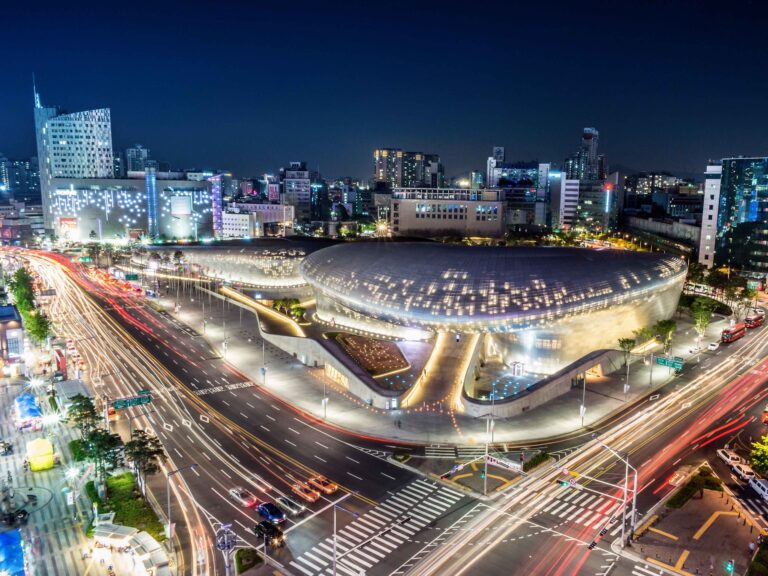
The historic core sits north of the river around Jongno (종로) and Gwanghwamun (광화문), where the palaces, the older streets, and the markets are. Hongdae (홍대) developed around a university and grew into a nightlife and independent culture district. Gangnam (강남) and Jamsil (잠실) south of the river are newer, larger in scale, and built around business, shopping, and residential life.
Each of these functions as a centre for someone. A hotel described as central is central to one of them, not all of them. That is the part booking sites cannot communicate.
Where the time actually goes
The transport system works. The time disappears in the parts that do not show up on a route map.
Transfers at major interchanges can involve several minutes of walking underground, sometimes with stairs and luggage. Station exits are numbered for a reason, and choosing the wrong one at a large station adds a surface walk on top of the journey. Buses move well in dedicated lanes and still follow traffic. Peak hours compress everything, and platforms fill quickly.
Some days are heavier than others. Festivals, marathons, protests, and large events around the centre can slow movement across whole districts for a few hours. None of it is unusual. It is simply what a city of this density does.
A journey listed as 35 minutes usually means 35 minutes of travelling. The walk to the station, the wait, the transfer, and the walk at the other end sit outside that number.
A test worth running before booking
Naver Map and KakaoMap both handle Seoul far better than international map apps. Both show real transfer times, station exits, and bus options. Both are worth downloading before the trip rather than during it.
Three journeys tell you most of what a hotel location will feel like.
If all three run under 40 minutes with one transfer or fewer, that address will hold up across a week. If two of them require crossing the river at rush hour, the hotel is asking for more than it gives back.
Seoul rewards a little planning at this stage. Once the distances are honest, the shortlist of neighbourhoods becomes obvious, and the hotels inside them become much easier to compare.